
Turning onboarding into brand judgement, not just awareness
 PepsiCo's new hires are expected to represent the brand from day one, in fast-moving markets where every customer interaction counts. Within weeks of joining, they're making decisions that reflect the company's mission and values under real commercial pressure - with no grace period between learning the brand and having to live it.
Unpractised values break down fast
At PepsiCo's scale, the risk during onboarding isn't a knowledge gap – it's inconsistent execution once new hires hit real friction. Values that haven't been rehearsed don't hold up under pressure:
New hires default to guesswork in ambiguous customer moments
Inconsistent decisions dilute the customer experience across markets
Brand behaviour fragments before it's had the chance to take root
The readiness gap
New hires could read about PepsiCo's mission and repeat its values back – the induction process was never short on information. What it didn't do was activate them. People understood the concepts but had:
No early opportunity to apply brand principles to a real, contextual decision
No safe space to test their judgement before a live customer moment
No practical reference for what "on-brand" actually looked like day to day
Onboarding delivered awareness. It didn't build capability. 99% of new hires said the experience gave them practical approaches they could use immediately.
A fast-paced rehearsal built around real choices
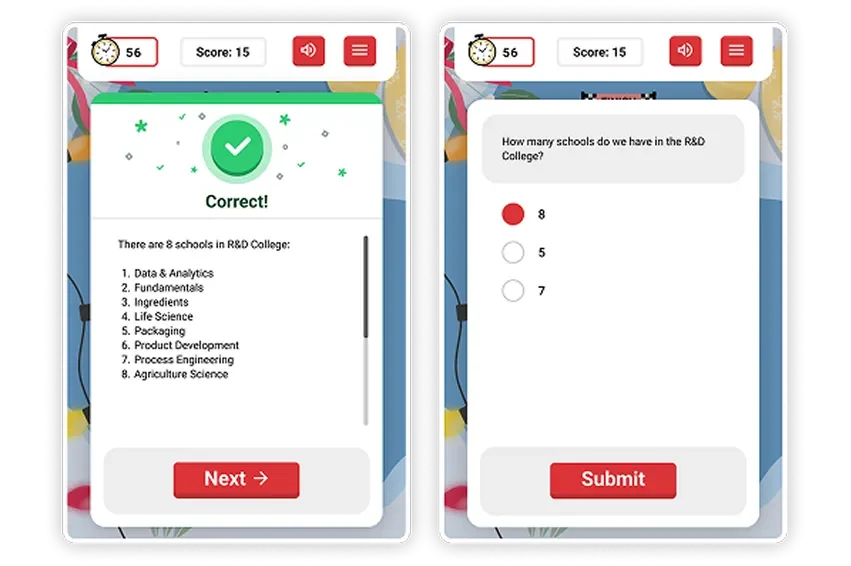
Totem built a fast-paced, interactive rehearsal around PepsiCo's mission and brand principles - not another module to read, but a series of live decisions to make. New hires stepped into scenarios that mirrored the ambiguity of the job, choice by choice.
It centred on three things:

Rapid-fire decisions
Rapid-fire decisions that mimicked real customer and operational pressure.

Brand principles in context
Brand principles applied in context, rather than explained in the abstract.

Immediate consequences
Visible, immediate consequences for every choice, rather than delayed feedback.

The performance shift
New hires who'd rehearsed these moments carried strong behavioural defaults into their first weeks - the values weren't abstract anymore, they were tools they'd already used. On the floor, that meant:
Faster decisions when ambiguity or customer pressure hit
Consistent, brand-aligned responses instead of individual guesswork
Confidence applying PepsiCo's mission in situations they'd effectively already faced
The Results
found it immediately useful
The shift from passive content to active rehearsal showed up immediately in the numbers. 99% of participants said they enjoyed the experience, 99% found the scenario-based challenges engaging, and 99% said it gave them practical approaches they could apply straight away in their roles. Rolled out globally in just three weeks, the programme proved that immersive, decision-based practice does two things traditional onboarding rarely manages together: it drives genuine engagement, and it builds operational alignment before a new hire ever faces a real customer.